
The Space Economy Moves From Frontier to Infrastructure
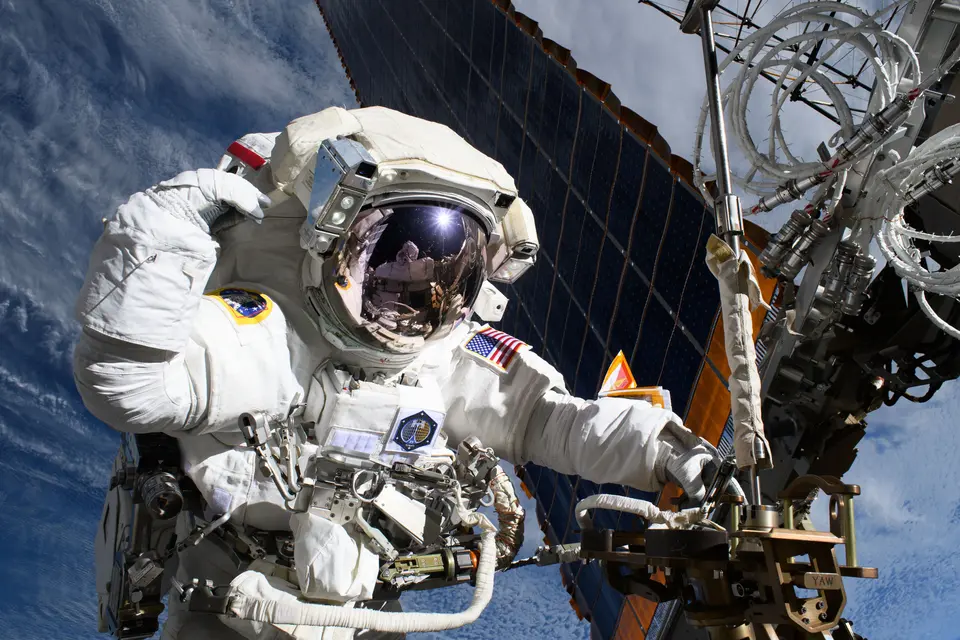
Space used to sit at the edge of the economy - a distant arena dominated by national agencies, scientific missions and a handful of aerospace contractors. That era is ending.
What was once a specialized government enterprise is becoming a broader platform for defense, communications, computing, manufacturing and, eventually, consumer activity. The commercial space economy is expanding alongside renewed geopolitical competition, while cheaper launches and private capital are pushing more business into orbit.
Recent industry estimates put the space-related defense market at roughly $90 billion to $120 billion, with projections that it could more than double to about $250 billion by 2035. That growth is being driven by many of the same forces reshaping security policy on Earth: rivalry among major powers, the need for resilient communications, rapid advances in autonomous systems and the recognition that satellites are no longer support tools. They are critical infrastructure.
The broader space economy has also grown quickly. One cited estimate put global space-economy revenues at $570 billion in 2023, nearly double the level of a decade earlier, with commercial revenues accounting for almost 80% of industry activity as of July 2024. Other projections suggest the global space economy could reach as much as $2 trillion by 2040.
The result is a new phase of the space economy. It is more crowded, more commercial and more contested.
Space Becomes the Strategic High Ground
Greater geopolitical uncertainty is sending governments back to space with new urgency. The reason is straightforward: modern militaries depend on orbital systems to see, move and communicate.
Satellites support navigation, surveillance, secure communications and other military operations, making space-based capabilities increasingly important to modern defense. In a conflict, losing access to those systems could quickly weaken a country's ability to operate on the ground, at sea or in the air.
That dependence has made space a central defense priority. Countries are no longer treating satellites as remote technical assets. They are treating them as strategic infrastructure.
The U.S. Space Force's share of defense spending has nearly doubled since it was established, according to the source material, with major projects under way including the Golden Dome missile-defense system. Other governments are also expanding dedicated military space capabilities as they recognize that control over orbital assets can shape outcomes in terrestrial conflicts.
The logic is circular and self-reinforcing. The more countries rely on space, the more they need to defend it. The more they defend it, the more space becomes a domain of military competition.
That competition is also drawing in the private sector. Commercial satellite operators, launch providers and data companies increasingly serve defense customers alongside civilian ones. In some cases, the same broad technology base that supports broadband, earth imaging or satellite services can also support defense communications, surveillance or resilience.
The New Space Race
The U.S. remains the world's largest space spender, but its dominance is less absolute than it once was. China has dramatically increased its ambitions, expanding its share of global space budgets from about 2% in 2000 to roughly 15% in 2024.
China's program now spans government activity and a growing commercial sector. Private investment in China has produced a surge in commercial space startups, echoing similar trends in other countries.
India is pursuing a different but increasingly influential model. It has built a reputation for low-cost launches for small satellites and aims to capture 8% of the global space market by 2033, a share projected at $44 billion. India now ranks second only to the U.S. in space startups, according to the source material.
Europe remains a significant player as well. It represented 22% of global private investment in space in 2024, a share valued at €1.5 billion. European companies and agencies are trying to preserve autonomy in launch, earth observation, satellite communications and navigation at a time when dependence on foreign infrastructure has become a political risk.
This new race differs from the Cold War version. Then, the competition was largely symbolic and state-led: flags, firsts and prestige. Today, the stakes are more practical. Countries are competing for orbital capacity, communications resilience, lunar access, launch economics and industrial advantage.
Manufacturing in Microgravity
Microgravity manufacturing may become one of the more important long-term commercial opportunities.
Certain materials and biological processes behave differently in orbit. Without gravity-driven sedimentation and convection, it may be possible to produce higher-value goods that are difficult to make on Earth. Space executives have pointed to applications in biopharmaceuticals and biotechnology, while noting that scaling the market depends heavily on solving the problem of bringing products back to Earth quickly and reliably.
The opportunity is not yet at scale. The hard part is logistics. Manufacturing in orbit is only useful if companies can return finished goods safely, affordably and on predictable timelines. That requires reliable reentry vehicles, storage systems, quality control and regulatory approval.
Still, the potential is significant. If orbit becomes a place to make products that cannot be made as well on Earth, space will no longer be merely a communications and observation platform. It will be an industrial environment.
Some executives envision a future in which advanced medical products, including printed organs, could be produced in space over a 15- to 20-year horizon. More near-term applications may come from specialty materials, biotechnology research and drug development.
The Lunar Economy Takes Shape
The moon is also moving from symbol to infrastructure.
The emerging cislunar economy - the zone spanning low Earth orbit, the moon and the space between them - presents opportunities in infrastructure, satellite servicing, resource extraction and long-duration logistics. Governments and private enterprises are exploring the foundations of a sustained human and robotic presence beyond Earth orbit.
Water ice at the lunar poles is one of the central targets. If it can be extracted and processed, it could support a fuel-based economy for deep-space transportation and longer-term lunar operations. That would change the economics of exploration by reducing the need to lift every kilogram of fuel from Earth.
Lunar infrastructure remains early and risky. But the direction is clear: companies and governments are looking at the moon not only as a destination, but as a potential node in a larger transportation, energy and resource network.
Tourism Tests the Consumer Market
Space tourism remains a small and uncertain market, but it has already changed public expectations.
The source material points to the rapid commercialization of space drawing interest from sectors beyond traditional aerospace, including hospitality. That does not yet amount to a mass market. For now, human spaceflight beyond government programs remains limited, expensive and dependent on a small group of customers.
Tourism matters for reasons beyond ticket sales. It can support the development of life-support systems, reusable vehicles, training programs, orbital habitats and private mission operations. Those capabilities could later serve researchers, manufacturers or government customers.
The long-term question is whether consumer-oriented space activity can move beyond novelty. That will depend on safety, price, reliability and the availability of destinations. A short suborbital flight is one product. A stay aboard a private space station is another. A lunar mission would be something else entirely.
For now, tourism is less a mass market than a proving ground. It tests whether commercial companies can safely and repeatedly move humans beyond Earth.
The Risks Are Also Multiplying
The same forces driving the space boom are creating new risks.
Lower launch costs are essential to almost every business model. If launch prices stop falling, or if major failures ground vehicles for extended periods, many projected markets could slow. Reliability matters as much as cost.
Geopolitics is another risk. Space is increasingly intertwined with defense, export controls, national-security reviews and cross-border competition. Companies operating across borders may face tighter restrictions on technology transfer, foreign investment and customer relationships.
Regulation is struggling to keep pace. Governments must manage spectrum allocation, launch licensing, debris mitigation, insurance rules and liability frameworks. The more satellites enter orbit, the more urgent those questions become.
Space debris is the most visible physical threat. The source material identifies debris, geopolitical uncertainty, regulatory uncertainty and launch failures as key risks as space becomes more closely tied to defense, technology and commercial ambition. Low Earth orbit is already crowded. More satellites increase the risk of collisions, which can create debris fields that endanger other spacecraft.
There is also a market risk: some space business models may arrive too early. Investors have seen this before in other capital-intensive sectors. A promising technology can still fail if customers are not ready, costs remain too high or supporting infrastructure is missing.
The space economy is expanding, but it will not expand evenly.
Public Companies in the Space Economy
Investors looking for publicly traded exposure to the space economy have a limited but growing set of companies. These are not pure proxies for the entire industry, and their risk profiles vary widely. Listing status, business mix and financial condition should be verified before making any investment decision.
Launch and Space Infrastructure
Rocket Lab (NASDAQ: RKLB): Provides dedicated satellite launch services (via the Electron rocket) and end-to-end space systems and manufacturing.
Intuitive Machines (NASDAQ: LUNR): Focuses on lunar exploration, cargo transportation, and building data infrastructure on the moon.
Satellite Communications and Broadband
AST SpaceMobile (NASDAQ: ASTS): Building the first space-based cellular broadband network aimed at providing worldwide direct-to-cell 4G and 5G connectivity.
EchoStar (NASDAQ: SATS): A major global provider of satellite communication solutions.
Earth Observation and Analytics
Planet Labs (NYSE: PL): Operates a large commercial constellation of Earth-imaging satellites, providing geospatial data and analytics to governments and private businesses.
These companies represent only part of the public space market. Larger aerospace and defense contractors also have significant space operations, though they are not always valued primarily as space companies. Telecommunications, semiconductor, software and energy firms may also gain indirect exposure as the industry matures.
A New Industrial Layer
The space economy is no longer defined by exploration alone. It is becoming an industrial layer above Earth, supporting defense, communications, computing, observation and, eventually, manufacturing.
The near-term engine is defense. Governments are spending because space has become essential to national security. But defense spending is also helping to build commercial infrastructure that can serve broader markets.
That pattern has precedent. Government demand helped support technologies such as GPS, advanced computing and communications before they became commercial platforms. Space may be following a similar path.
The difference is that the operating environment is harsher, the capital costs are higher and the geopolitical stakes are more immediate. Success will depend on cheaper launch, better reliability, smarter regulation and the ability to manage congestion in orbit.
The next decade is unlikely to produce a single space economy. It will produce several: a defense economy, a satellite economy, a lunar economy, a data economy and perhaps an orbital manufacturing economy. Some will mature quickly. Others will remain speculative for years.
But the direction is clear. Space is moving from the edge of policy and commerce toward the center. The countries and companies that build the infrastructure now may shape the next era of growth beyond Earth.